


Online AI and Privacy
Craftwise
·décembre 17, 2025
On this page:
Artificial intelligence (AI) systems that operate online typically require user input to be transmitted to remote servers for processing. This includes text, voice, images, and other forms of data. The transmission of this data is a fundamental part of how such AI services function, as the processing is performed on servers located outside the user’s device.
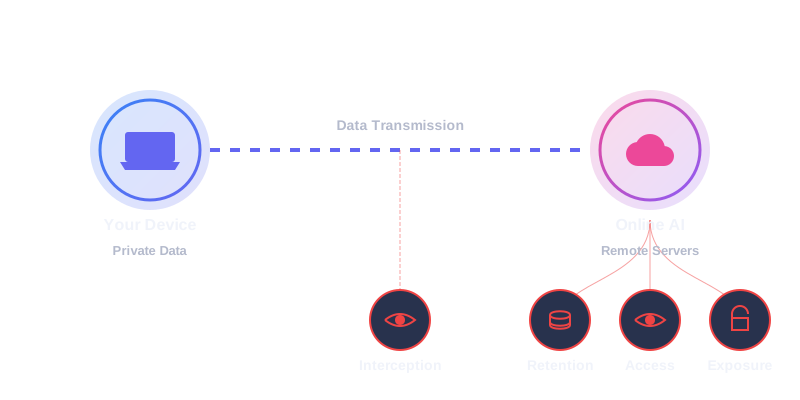
All online AI services transmit data to remote servers. This is not an exception, but a standard operational requirement. Once transmitted, the data may be stored, processed, and used for various purposes, including improving the AI system, generating responses, or other secondary uses.
Stanford’s Foundation Model Transparency Index have shown that data retention policies vary, but many services retain user data for periods ranging from days to years. Some services do not provide clear information about how long data is stored, nor do they always provide straightforward methods for users to request deletion. In some cases, data may be retained beyond the user’s expectation or consent, even when the user has opted out of data usage for training purposes.
This data collection and storage process raises significant privacy concerns. Once data is stored on a server, it is no longer under the user’s direct control. It may be accessed by third parties, used for purposes other than those intended by the user, or exposed in the event of a data breach, an increasing risk in light of rising cyber threats in recent years.
An alternative approach is the use of local AI processing, in which the AI model runs entirely on the user’s device, without the need to transmit data to external servers. In this model, all data processing occurs on the user’s computer or mobile device, and no data is sent to the cloud.
Local AI eliminates the risk of data transmission and storage on external servers. As a result, user data remains private and is not subject to third-party access, retention, or use. This approach also reduces dependency on internet connectivity and can provide more consistent performance in environments with limited or unreliable network access.
While local AI may be limited by the computational power of the local device, it offers a clear and effective method for ensuring data privacy and user control.
Summary
- All online AI services transmit user data to remote servers for processing.
- Data may be retained for extended periods, even if not used for training.
- Data stored on servers is subject to third-party access, breaches, and unintended uses.
- Local AI processing prevents data from being sent or stored externally, ensuring greater privacy and control.
- Local AI is limited by the computational power of the device it runs on.
This distinction is critical for users who prioritize data privacy and want to minimize the risk of unauthorized data exposure.